
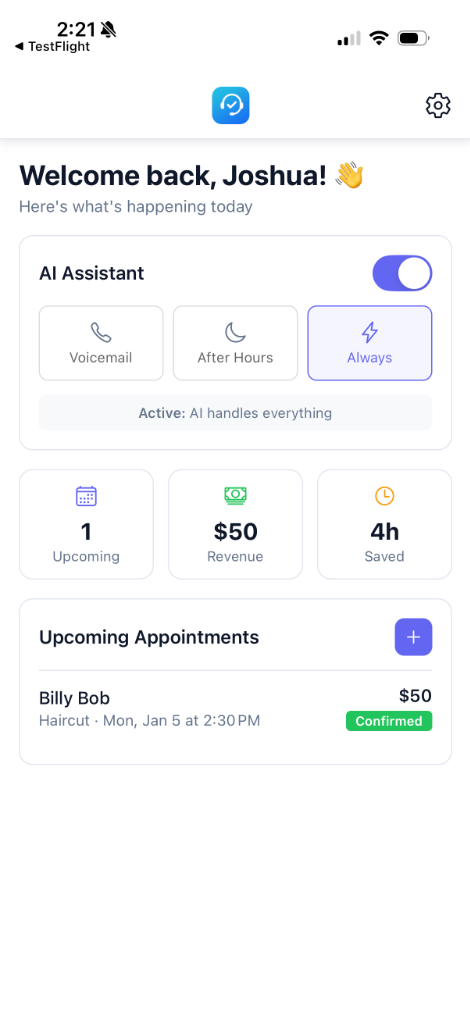
Project information
- Overview: An intelligent scheduling platform that leverages voice and conversational AI to connect service providers with clients through natural language interactions.
- Role: Founder, Designer & Developer
- Duration: Ongoing (2024-Present)
- Tech Stack: React, TypeScript, Vite, Supabase, Tailwind CSS, Twilio
- Problem: Traditional scheduling tools rely on rigid forms and manual entry, leading to friction and high abandonment rates.
- Goal: Design a frictionless conversational interface that handles scheduling via voice and chat as naturally as a human assistant.
The Challenge
Service providers—hairstylists, consultants, personal trainers—spend significant time managing appointments. Existing tools either lack features or require complex setup. Clients, meanwhile, struggle with back-and-forth communication to find available times.
Manual Coordination
Providers spend hours each week texting, calling, and managing calendars instead of focusing on their craft.
No-Shows & Conflicts
Without automated reminders and real-time sync, double-bookings and no-shows hurt revenue and reputation.
Fragmented Communication
Appointments arranged via text, phone, and DMs create confusion. Clients want a single, easy booking experience.
Solution Architecture
Schedulix combines a modern React frontend with Supabase backend, enabling real-time updates, authentication, and phone integration through Twilio. The architecture supports both web and mobile experiences.
- Calendar view with drag-and-drop scheduling
- Service management (pricing, duration, descriptions)
- Business hours and availability settings
- Client database with history
- Analytics on bookings and revenue
- Real-time availability display
- Service selection with pricing
- Instant booking confirmation
- SMS and email reminders
- Easy rescheduling and cancellation
Key Features
Conversational AI Design
At the heart of Schedulix is a sophisticated conversational engine. By designing for natural language, we've replaced complex forms with intuitive voice and chat interfaces that understand intent and context.
Real-time Sync
Supabase real-time subscriptions ensure instant updates. When a client books, the provider sees it immediately—no refresh needed.
Smart Reminders
Automated SMS and email reminders reduce no-shows. Configurable timing lets providers choose 24-hour, 1-hour, or custom reminder windows.
Branded Booking Pages
Each provider gets a customizable public booking page. Clients can browse services, see availability, and book without creating an account.
Design Process
Building Schedulix from conception to deployment gave me complete ownership of the product lifecycle. Key milestones included:
Discovery
Interviewed service providers to understand scheduling pain points
Design
Created wireframes and prototypes in Figma with rapid iteration
Development
Built full-stack with React, TypeScript, Supabase, and Twilio
Launch
Deployed to Vercel with CI/CD and real user testing
Technical Highlights
- Supabase Row Level Security (RLS) - All data access governed by policies ensuring providers only see their own appointments and clients.
- Edge Functions - Serverless functions handle Twilio webhooks, reminder scheduling, and background tasks.
- OAuth Authentication - Google OAuth for seamless provider sign-up and sign-in.
- Mobile-First Responsive Design - Both providers and clients can manage appointments from any device.
Reflections & Next Steps
-
Full-Stack Ownership
Building Schedulix end-to-end deepened my understanding of the entire product development lifecycle—from user research to production deployment.
-
Conversational AI & Voice Interaction
Expanding the voice assistant's capabilities to handle complex rescheduling requests and multi-service bookings through advanced natural language processing.
-
Mobile App
Currently building a React Native (Expo) mobile app for providers to manage bookings on the go.